
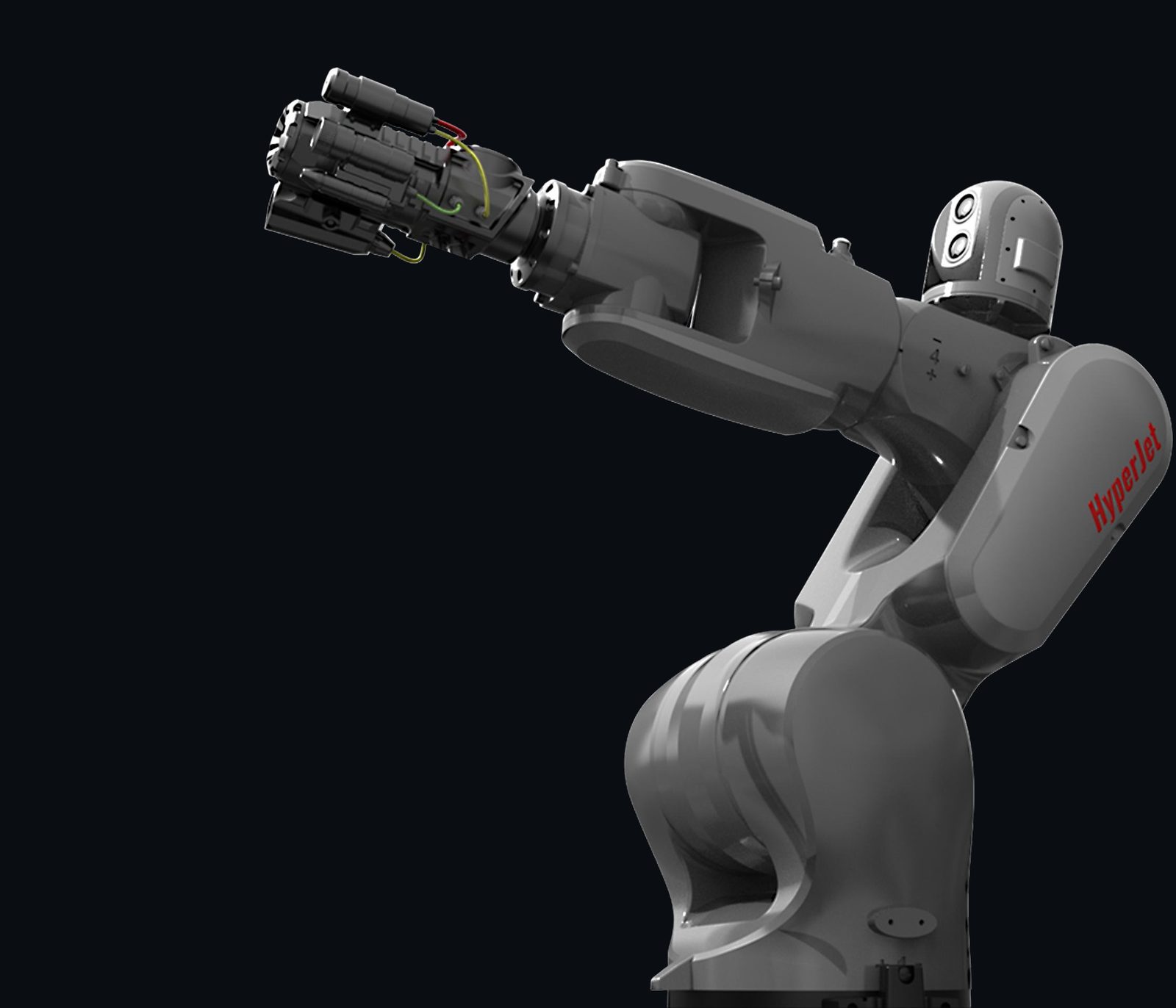
Close-range hard-kill counter-UAS
The kinetic effect of a weapon. Without conventional ammunition.
HyperJet destroys drones with supersonic liquid projectiles, from single FPVs to dense swarms. A long burst costs cents, so armed forces and civilian sites can engage every drone that threatens them.
- No cartridge
- No combustible propellant
- No explosive warhead
- No solid projectile
Key figures
- ≈ 980 m/s Projectile velocity at the muzzle (Mach ~3)
- up to 30,000 Projectile groups per minute
- 120–130 J Projectile group energy at target, 50 m Measured
- 2 MOA Accuracy at 50 m Measured
- 560°/s Turret slew rate, both axes Measured
- Working engineering prototypes
- Small-series manufacturing
- Integration and demonstration work with defence advanced-development departments in several countries
Problem
Small drones changed air defence
Small drones are getting cheaper, more numerous and more capable, and detection, tracking and classification keep improving. Physical defeat remains the hardest part of the engagement chain. Existing methods force operators to trade cost, magazine depth, rate of fire, logistics, legal complexity, collateral risk and flexibility against each other. Defeating many drones continuously and at low cost remains difficult.
Firearms
They need ammunition, carry collateral risk and fall under firearms regulation.
Missiles and interceptors
Each shot is expensive, and the magazine is small.
Lasers and microwave
They need kilowatts of power and dwell time on each target, and the atmosphere limits their effect.
Jamming
It does not stop fibre-optic or autonomous FPVs.
Nets
A launcher cannot sustain many engagements.
Each engagement is therefore rationed. Operators fire only when they are sure of the target, and most sites outside the military cannot fire at all.
Beyond the battlefield
The missing layer
Military air defence already exists. FPV attack videos changed how the public sees drones, and the concern has spread to operators of infrastructure, transport, industrial sites and public venues, to private security services and to owners of high-value assets. Many of them have no practical hard-kill option. This leaves a large market between passive detection and military air defence. Counted by the number of assets to protect, it may become larger than the military one.
Without practical defence that can be deployed widely, societies respond to misuse with restrictions and bans. Defence allows society to keep accepting drones and the drone economy to grow.
Advantage
What HyperJet changes
The magazine is a tank of water-based fluid. A shot leaves no ricochet, fragments, casings or lead. Engagement is no longer rationed.
Swarms
A rate of fire of up to 30,000 projectile groups per minute and a turret slew rate of 560°/s let one turret engage targets in quick succession.
Uncertain targets
The system can fire when it cannot tell a drone from a plastic bag in the air.
Graded response
The operator sets the intensity, from driving away a camera drone or a flock of birds to destroying an FPV.
Any guidance
The effect is physical, so fibre-optic-guided and autonomous FPVs are engaged in the same way as radio-controlled ones.
The same system serves armed forces and civilian operators.
Technology
How HyperJet engages a drone
A high-speed drone may stay inside the engagement zone for only a few seconds. In that time the system detects the target, aims, fires, checks the result and continues or moves to the next target.
The turret does the coarse aiming, and each shot is steered electronically inside the barrel. A shot is a group of droplets of a water-based fluid that acts close to a solid body on impact. Beyond the engagement zone the droplets lose their energy.

Applications
Applications
Armed forces can use HyperJet as a close-in layer against FPVs and swarms. Fixed sites such as airports, energy and industrial facilities can protect themselves with it, and mobile systems can protect people, convoys and vessels. The same mechanism drives birds away from sensitive sites, and C-UAS integrators can add it to their systems as a hard-kill module.


Network
One pump station, up to eight turrets
The pump station holds the fluid tank, the 7,000-bar class pump and the power supply, and feeds up to eight turrets through high-pressure lines. Stations can be networked for hot swap.
Software coordinates detection, target selection and fire control across turrets and stations.

Company
Status and funding
HyperJet has been founder-funded since inception and has active paid contracts with EU defence agencies. The core hydraulic, nozzle and control subsystems are designed, built and tested.
The company is raising €5M to complete fire control, tracking and engagement automation and to build a complete operational system.
- TRL 5 Working engineering prototypes
- Production Prototype and small-series manufacturing
- Facility Laboratory and workshop
- Ownership Hyperjet SASU, France, is a wholly owned subsidiary of Nonnewtonian SL, Spain, which holds the technology
Contact
Request a briefing
For briefings, investment, integration and press enquiries.